
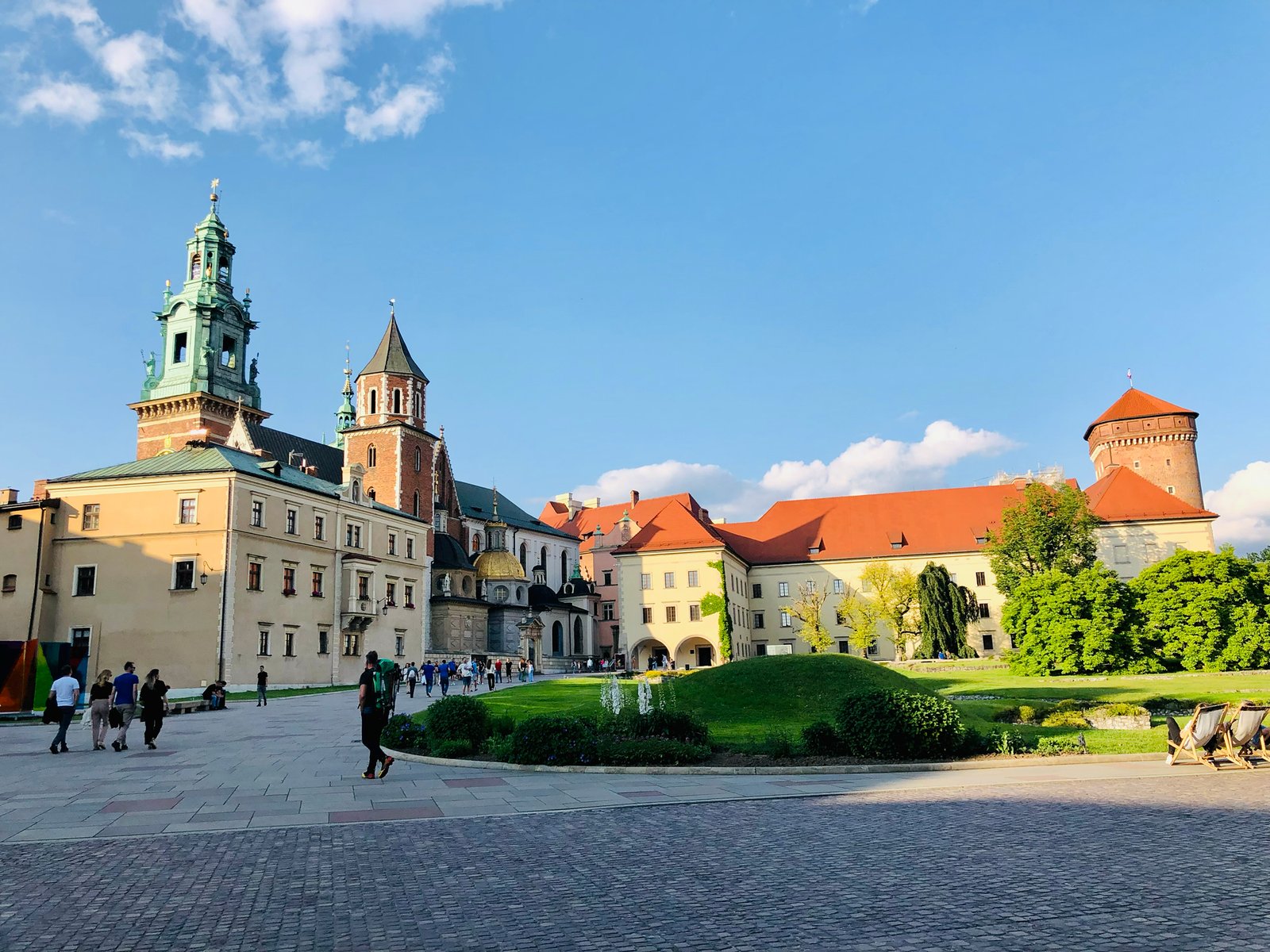
I didn’t plan to fall for Krakow. I arrived with zero expectations and a laptop full of spreadsheets, tucked away in a hotel room that happened to overlook the Vistula River and Wawel Castle. But the city had other plans. Somewhere between the salt mines that made me forget I was underground, a medieval square that felt suspended in time, and the surprisingly warm hospitality of the locals (fueled, perhaps, by a few shots of nalewka), Krakow stopped being a mere backdrop for meetings and became one of my favorite cities in Europe.
I tagged a few extra days onto either side of my work schedule, only to find a city that rewards curiosity at every turn. From the intricate “underground cathedrals” of Wieliczka to the sobering weight of history at Auschwitz, and even the simple joy of folding my own pierogi by hand, Krakow left its mark. Below, you’ll find my top eight experiences in the city, followed by a sample four-day itinerary to help you plan your own escape.
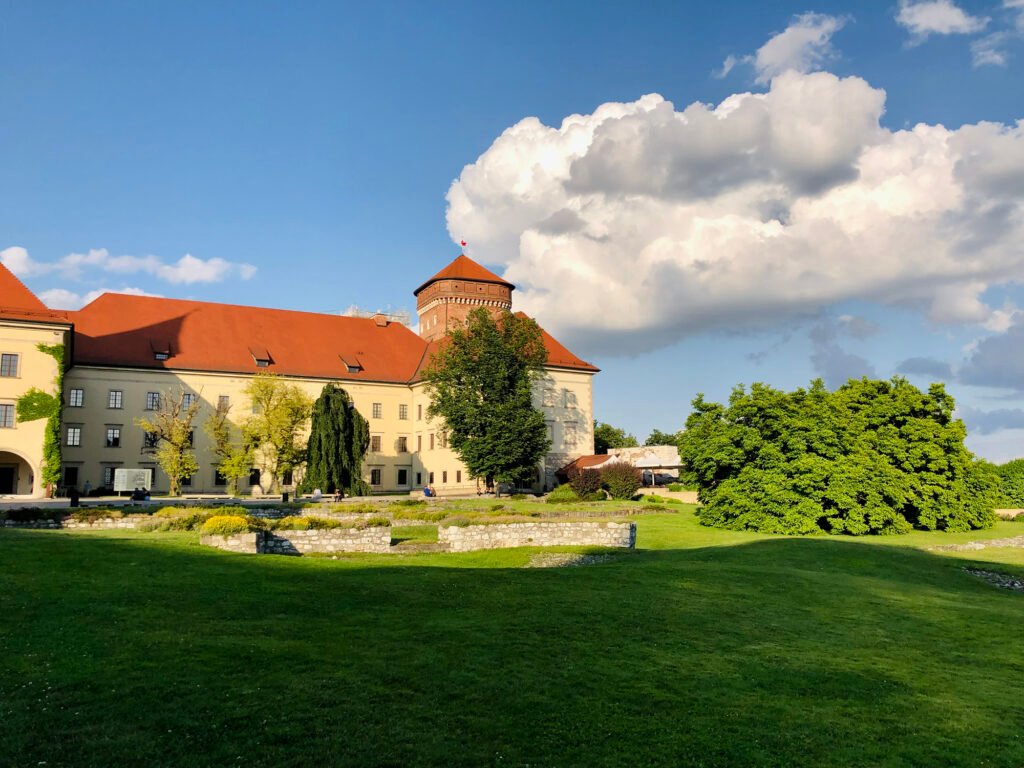
Table of Contents
🏅 Top Things to Do in Krakow
Krakow packs a remarkable amount into a compact, walkable city. These are the eight experiences that stood out most from my trip – a mix of history, culture, food, and moments that surprised me. Whether you have a long weekend or a full week, any combination of these will give you a rich sense of what makes this city so special.
1. 🏰 Old Town & Main Square
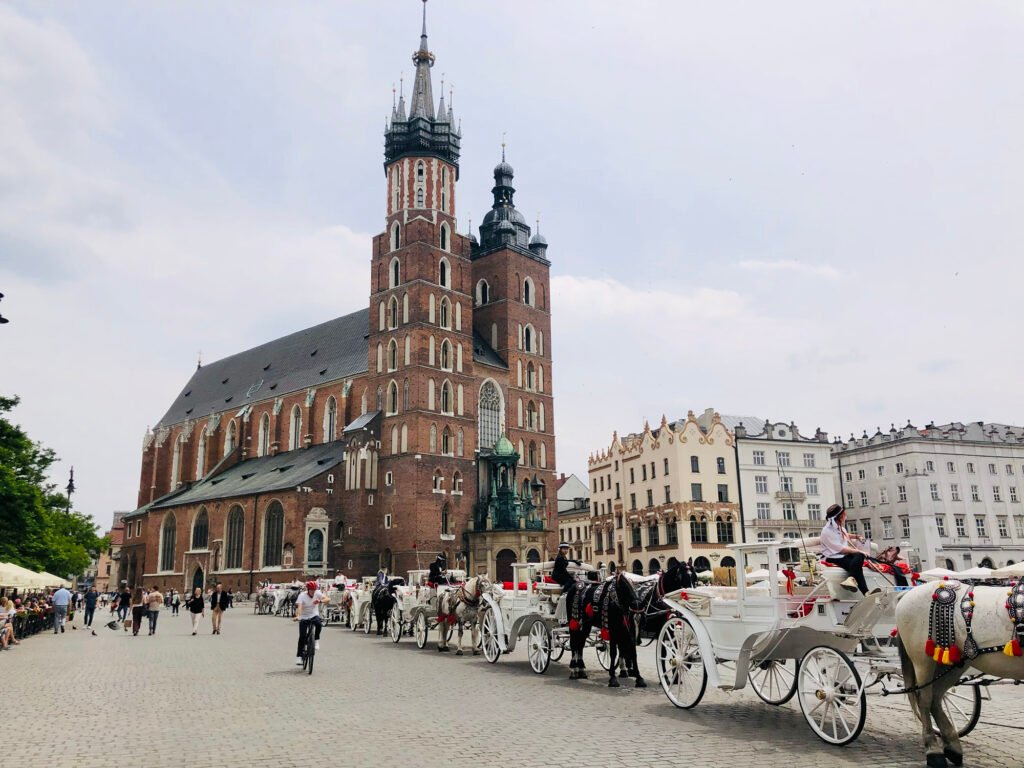
Krakow’s Main Square (Rynek Główny) is one of the largest medieval town squares in Europe, and it earns every inch of its reputation. The first time I walked into the expanse, the scale caught me off guard: the vast cobblestone floor, the twin towers of St. Mary’s Basilica piercing the skyline, and white horse-drawn carriages clip-clopping past the long, elegant arcade of the Cloth Hall. It feels like stepping into a pocket of history that time simply forgot to age.


I spent an afternoon wandering with no agenda – just following whatever caught my eye. That is the beauty of Krakow’s Old Town: it is compact enough that you can’t truly get lost, yet layered enough that every side street feels like it’s hiding a secret worth finding.
In the corner of the square, the Eros Bendato sculpture stopped me mid-stride. A massive bronze head, hollowed out and resting on its side by Polish sculptor Igor Mitoraj, it sits in beautiful, surreal contrast to the ancient backdrop. It seems to have a magnetic pull; every person walking past felt compelled to peer into its empty eyes.
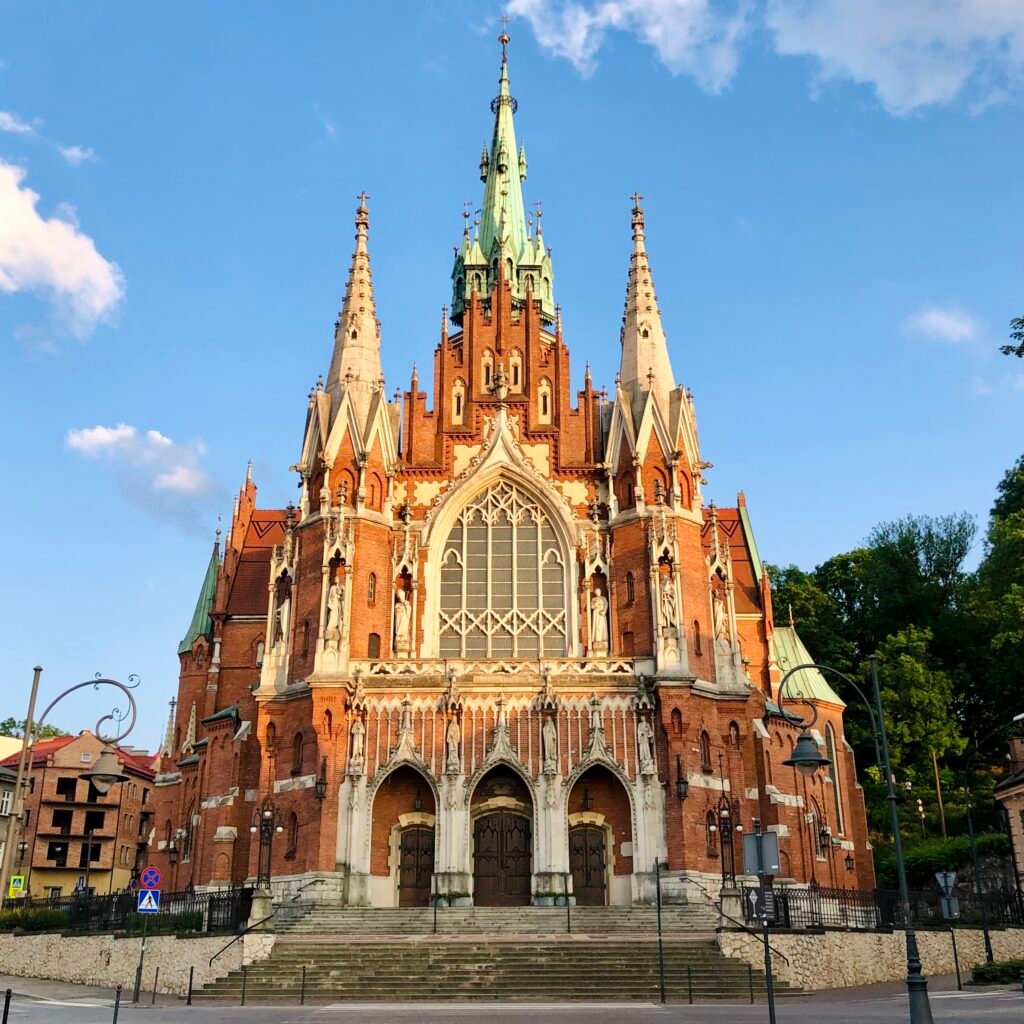
Pro Tip: If you’re walking between Old Town and the southern neighborhoods (toward Podgórze or Schindler’s Factory), keep an eye out for St. Joseph’s Church (Kościół św. Józefa) – a stunning red-brick neo-Gothic church that’s not on most tourist itineraries but probably should be. The facade is jaw-dropping – soaring red brick against the sky, the kind of building that makes you stop mid-step and reach for your camera. It’s worth a detour just to stand at the bottom of those steps and look up.
2. 👑 Wawel Castle, Cathedral & the Dragon
Perched on a limestone outcrop overlooking the Vistula, Wawel Royal Castle is an architectural shapeshifter. During the day, I wandered the cathedral courtyard with colleagues, mesmerized by the layers of Romanesque, Gothic, Renaissance, and Baroque styles stacked atop one another. Wawel Cathedral is the heart of Polish history – the site where kings were crowned and buried for centuries – and the weight of that legacy is palpable as you stand before its golden domes.


While the history is impressive by day, the view that stayed with me was at night. From the riverbank below, the castle glows against the dark sky, its towers illuminated in warm gold while the Vistula reflects the shimmer back. With locals scattered on the grass for picnics and quiet conversation, it’s one of the most serene urban scenes I’ve ever stumbled into.

From the castle grounds, the panorama is just as striking: the river stretching toward the horizon, a Ferris wheel spinning on the far bank, and a lush green canopy lining the waterfront.


And then, there’s the dragon.
Krakow’s most famous legend is the tale of Smok Wawelski (the Wawel Dragon), a story dating back to the 12th century. As the legend goes, a fearsome beast lived in a cave beneath the hill, terrorizing the city until King Krak promised his daughter’s hand to whoever could slay it. While knights failed with swords, a clever cobbler named Skuba succeeded with a sheep stuffed with sulfur. The dragon devoured the bait and became so thirsty he drank from the Vistula until he literally burst.
Today, a bronze statue of the dragon by sculptor Bronisław Chromy (installed in 1972) stands guard at the base of the castle. Every fifteen minutes or so, it actually breathes a plume of real fire. It is delightfully absurd: a serious, centuries-old royal fortress above, and a fire-breathing metal monster below, surrounded by cheering tourists.
Dragons are the heartbeat of Krakow – they’re on shop logos, mascots, and children’s books. I even flew home with a few dragon souvenirs and a beautifully illustrated storybook gifted to me by a colleague. It sits on my bookshelf now – a perfect reminder of a city that takes its legends just as seriously as its history.
3. 🎨 Czartoryski Museum & Lady with an Ermine
Growing up, I always loved appreciating art, but if I’m being entirely candid, I often feel like I don’t quite know how. That was the question in my mind when I walked into the Czartoryski Museum. I told myself: Let’s just check one museum off the list while I’m here, even if I don’t fully “get” the pieces.
Like many visitors, I grabbed a booklet and headed straight for the museum’s crown jewel: Leonardo da Vinci’s Lady with an Ermine. It is one of only four surviving portraits of women by the master, and the weight of that rarity is felt the moment you enter the room.


I expected a quick glance – a “check the box” moment. Instead, I found myself standing in front of the painting for a long time. What struck me was the staggering intimacy of seeing Leonardo’s actual brushstrokes just inches away. I noticed the individual strands of hair, the ermine’s tiny, delicate claws, and the way the subject’s fingers curl around the animal with an impossible combination of tenderness and precision. As the gallery lighting shifted, the painting seemed to change with it. It was more refined and more beautiful than I could have imagined – a surprisingly meditative experience that felt like a moment of pure calm.
Tour Breakdown
- 🎫 Cost: 65 PLN (~$16 USD) for adults. Free on Tuesdays (timed ticket still required).
- ⏱ Duration: Allow 1–2 hours to explore the full museum.
- 📍 Location: Czartoryski Museum, św. Jana 19 (Old Town).
- 💡 Pro Tip: Go early or late in the day to avoid the crowds clustered around the Leonardo. Don’t rush; find a spot to sit with the painting and just breathe.
4. ✡️ Kazimierz, Schindler’s Factory & Zabłocie
Kazimierz was the heart of Jewish life in Krakow for over 500 years before the devastation of WWII. Today, the neighborhood strikes a poignant balance between deep reverence for its past and a vibrant, creative present. It is one of the city’s most walkable districts, and I found the best way to peel back its many layers was on foot.
I joined a walking tour with Walkative!, which was the perfect way to navigate a neighborhood that could easily be misread as just another “trendy” quarter. Our guide was sharp and clearly in love with the city’s soul. While the specific dates and names might fade over time, the feeling remains – that sense of a place with story upon story, and a guide who knew exactly how to make us care about every single one.
Traces of Jewish heritage are everywhere: the Old Synagogue, with its iconic exterior staircase, stands as a dignified reminder of the community that built it. Around every corner, you’ll find vivid, Chagall-style murals bursting with folklore, Hebrew inscriptions on weathered doorframes, and bronze statues tucked into quiet courtyards.


One detail I loved was the statue of a man sitting contemplatively on a bench (the Jan Karski monument). There’s something about a sculpture that invites you to sit down beside it – it shifts the pace from “sightseeing” to something much more personal.


Tour Breakdown
- 🎫 Cost: Tip-based (~$10–15 USD per person is a respectful baseline; expect to tip ~$20–30 USD per person for a great experience).
- ⏱ Duration: ~2.5 hours.
- 📍 Meeting point: Usually near St. Mary’s Basilica or the Old Synagogue (check your booking).
- 🔗 Booking: Jewish Kraków: Kazimierz & Former Ghetto Walking Tour
- 💡 Pro Tip: The tour provides a fantastic historical framework, but leave an hour afterward to explore the cafes of Plac Nowy on your own.
Crossing to Zabłocie: Schindler’s Factory
From Kazimierz, it’s a scenic 15-minute walk across the Bernatka Footbridge – a pedestrian bridge lined with love locks – into the district of Zabłocie. This is where you’ll find the Oskar Schindler Enamel Factory Museum.
This is a must-visit for anyone looking to understand Krakow under Nazi occupation. Rather than just a story of one man, the museum uses immersive exhibits and personal accounts to make the past feel startlingly present. It is a sobering, expertly curated experience that deserves your full attention.
Tour Breakdown
- 🎫 Cost: ~36 PLN (~$9 USD) for adults; Free on Mondays (book weeks in advance).
- ⏱ Duration: Allow 1.5–2 hours for a guided tour.
- 📍 Location: Lipowa 4, Zabłocie.
- 💡 Pro Tip: Book in advance. Tickets sell out rapidly, especially in the summer. A guided tour is highly recommended here to provide context for the dense archival material.
If you have extra time in the area, check out the Ethnographic Museum for a deep dive into Polish folk traditions, or the Museum of Illusions for a fun, lighter interlude after the weight of the historical sites.
5. ⛏️ Wieliczka Salt Mine
Nothing quite prepared me for the Wieliczka Salt Mine. I visited with my colleagues as part of a team-building excursion, and it has since become one of the most memorable “off-sites” of my career.
Our journey began with a descent that felt never-ending: a narrow, wooden spiral staircase that winds down, and down, and down. For ten minutes of nonstop turning, the walls close in and the air shifts. By the midpoint, our group was slightly breathless and wondering exactly what we’d signed up for. When we finally hit the first landing – Level I, 64 meters deep – I remember thinking: Wait, this is only the beginning?
But then, the mine opens up into a subterranean world. We wandered through chamber after chamber of salt-carved sculptures and emerald reflection pools. Seeing the statue of Copernicus carved entirely from salt was striking, as was the Józef Piłsudski Grotto, where the still water creates a perfect mirror of the jagged walls above. We learned about the grueling labor of the miners and the horses that lived underground; it was a sobering reminder of what “hard work” really means. (I joked to my team leader that maybe he brought us here so we’d appreciate our climate-controlled office jobs more!)


Then, we reached St. Kinga’s Chapel.
I don’t think I can overstate the impact of this room. At 101 meters below the surface, you walk into a massive cathedral with soaring ceilings and chandeliers made of shimmering salt crystals. Everything, from the floor tiles and the altar, to the intricate biblical bas-reliefs, is carved from rock salt. This wasn’t built as a tourist attraction; it was a genuine place of worship carved by miners over centuries. Knowing that three men spent nearly 70 years on this decorative work gives the chapel an authenticity that feels extraordinary.
Fun fact: the “salt” here is actually “Green Salt” (it looks grey in its natural state). It’s a type of rock salt that’s much harder than table salt, which is why they could carve such detailed statues!


The finale of our trip was the exit via the original “miner’s lift.” The line was long, and when our turn finally came, our group of ten decided to cram into a single, tiny elevator cabin. A colleague snapped a selfie of us all packed in like sardines, laughing about how this was the most “intense teamwork” we’d done all week. Honestly, that cramped, laughing moment in a metal box might be my favorite memory from the entire trip.
Tour Breakdown
- 🎫 Cost: 143 PLN (~$36 USD) for an English-language tour. If you book a package including round-trip transport from Krakow, expect to pay between $45 and $55 USD.
- ⏱ Duration: ~2.5 to 3 hours for the “Tourist Route.”
- 📍 Location: Wieliczka (roughly a 20–30 minute drive from Krakow city center).
- 💡 Pro Tip: Wear comfortable walking shoes and bring a light jacket. Even if it’s a heatwave outside, the mine stays a constant, cool 14–16°C (57–60°F) year-round.
- ⚠️ Note: Tickets frequently sell out days in advance; booking online via the official site or a reputable tour provider is highly recommended.
6. 🕊️ Auschwitz-Birkenau
Some places resist being written about, and Auschwitz-Birkenau is one of them. I visited on a guided day trip from Krakow, and I’m grateful I had a guide to provide context. The sheer, haunting scale of Birkenau, in particular, is nearly impossible to comprehend without someone walking you through the gravity of what you’re seeing.
The sensory details stay with you: the rusted fence posts stretching into the gray horizon at Birkenau; the railway tracks leading directly through the “Gate of Death”; the cynical iron letters of Arbeit Macht Frei at the entrance to Auschwitz I.


I don’t want to over-write this section. Certain experiences ask you to simply be present, and this was one of them. I may share a fuller, separate reflection at some point, but for now, my advice is simply: Go. Go with a guide, give it the full day it requires, and allow yourself the space to sit with it afterward.
Tour Breakdown
- 🎫 Cost: ~110–160 PLN (~$28–40 USD) for a guided tour; packages including transport from Krakow usually cost $45–$65 USD.
- ⏱ Duration: ~7–8 hours (including transport from Krakow).
- 📍 Departure: Most tours pick up from Krakow city center.
- 🔗 Booking: Airbnb Experiences, GetYourGuide, or local operators.
- 💡 Pro Tip: Book well in advance, especially in summer. Bring water and wear comfortable shoes – you’ll walk a lot. Allow yourself quiet time that evening back in Krakow to decompress – perhaps with a walk along the Vistula or a simple dinner.
- ⚠️ Note: There are strict security rules – bags larger than 30x20x10 cm are not allowed inside.
7. 🥟 Pierogi Cooking Class
If Krakow has an unofficial mascot, it might be the pierogi. And the best meal I had on this trip wasn’t found in a restaurant – it was the one I pinched, folded, and boiled with my own two hands.
I’ll be honest about why this experience called to me: I grew up making dumplings. In my culture, wrapping dumplings is a sacred kitchen tradition, especially during festivals. It’s a craft you learn by standing next to an elder, trying to mimic their lightning-fast thumb-press. When I realized pierogi were essentially Poland’s answer to the dumpling, I was hooked. Same heart, different technique? I had to find out.
Our class kicked off at 10:30 AM, and by the time we sat down to feast three hours later, I had flour in my hair and a newfound respect for the humble pierog. We crafted the dough from scratch – rolling, cutting, and learning exactly how thickness dictates the final bite. We moved through a library of fillings: savory meat, a bright spinach-and-cheese blend, and the classic potato-and-onion Ruskie.
The muscle memory from my childhood was there – the rhythm of filling and sealing – but the nuances surprised me. Polish dough has a unique elasticity, and the folding logic has its own flair. You can go for the simple “half-moon” press or the advanced “decorative pinch” that creates beautiful ridges along the edge. My first few looked a bit “rustic,” but by the sixth attempt, I was finally finding my groove.


And then we ate. Our creations were served on stunning Bolesławiec stoneware – traditional blue Polish pottery with its distinctive peacock-eye pattern. We had golden, pan-fried pierogi on one plate and buttery, boiled ones on another, accompanied by a bowl of hearty Polish soup and a tiny glass of nalewka (fruit liqueur) to wash it all down.


Whether you grew up with a dumpling tradition or are picking up a rolling pin for the first time, this class is a must. It was easily one of the best meals of the trip, and it tasted even better knowing I’d earned every bite.
Tour Breakdown
- 🎫 Cost: ~200–450 PLN (~$50–110 USD) depending on provider; includes ingredients, snacks and drinks.
- ⏱ Duration: ~3 to 3.5 hours.
- 🔗 Booking: Airbnb Experiences, GetYourGuide, or local operators.
- 💡 Pro Tip: Come hungry! You’ll eat everything you make, and it’s a lot of food.
8. 🎹 Chopin Concert
I saved this for my final evening in Krakow, and I am so glad I did.
Having trained in classical piano from a young age, Chopin’s music was a pillar of my education. I spent years practicing his nocturnes, waltzes, and mazurkas – clumsily at first, then with more nuance as I grew. To sit in a small, hushed room in Poland, Chopin’s homeland and the very soil that inspired the folk melodies within his compositions, felt like a profound homecoming
The concert took place at the Chopin Gallery on ul. Sławkowska. This isn’t a cavernous, intimidating concert hall; it’s an intimate, candlelit space within a historic building that holds maybe eighty guests. That proximity is the magic of the experience. You are close enough to hear the mechanical whisper of the piano keys and watch the pianist’s hands fly across the board in a way that a grand venue simply doesn’t allow.
The performance lasted about an hour, but the impact lingered much longer. There is a fundamental difference between playing Chopin’s scores on my own piano at home and hearing them performed by a professional in the land where the polonaise was born. The notes were familiar, but the context was entirely new. The flicker of the candlelight and the shared silence of the audience made these “familiar” pieces feel like something I was hearing for the very first time.
If you have any connection to classical music, or even if you don’t, I’d recommend this. It is an unexpectedly moving tribute to Polish identity and a perfect, quiet coda to a trip through this vibrant city.
Tour Breakdown
- 🎫 Cost: 70–85 PLN (~$18–22 USD). Tickets are often cheaper when booked online in advance, and typically include a complimentary glass of wine.
- ⏱ Duration: ~1 hour.
- 📍 Location: Chopin Gallery, ul. Sławkowska 14 (Old Town).
- 🔗 Booking: Available online through GetYourGuide, Viator, or the venue directly
- 💡 Pro Tip: Arrive 15 minutes early to secure a seat in the front rows. Being able to see the pianist’s hands adds a whole new dimension to the performance.
🗓️ Sample 4-Day Itinerary
Here is how I would organize these experiences into a seamless four-day trip. I spread mine out around work meetings, but if I had four full days of pure exploration, this is exactly how I’d spend them.
Day 1: The Royal Heart of Krakow
Start by immersing yourself in the medieval atmosphere of the Old Town.
- Morning: Wander the Main Square (Rynek Główny). Take your time with St. Mary’s Basilica and the Cloth Hall, and find the hollow Eros Bendato sculpture. Grab a coffee at a sidewalk café and simply people-watch.
- Afternoon: Head up the limestone hill to Wawel Castle & Cathedral. Allow 2–3 hours to explore the royal courtyards and the tombs of kings.
- Evening: Descend to the riverbank to see the Wawel Dragon breathe fire, then take a sunset stroll along the Vistula. The castle illuminated at night is a sight you shouldn’t miss.
Day 2: Jewish Heritage & Contemporary History
A day dedicated to the layered stories of the south-bank neighborhoods, capped with world-class music.
- Morning: Join a Kazimierz Walking Tour (~2.5 hours). It’s the best way to understand the history of the Jewish Quarter before it became the trendy arts district it is today.
- Afternoon: Walk across the Bernatka Footbridge (look for the “love locks”) into the Zabłocie district. Visit Schindler’s Factory for an immersive look at Krakow during WWII.
- Evening: Head back to the Old Town for a Chopin Concert at 7:30 PM. After a day of heavy history, an hour of candlelight and piano is the perfect way to decompress.
Day 3: The Deep Dive (Choose Your Own)
Krakow’s two most famous day trips are emotionally and physically demanding; I recommend choosing one to keep a relaxed pace.
- Option A: Auschwitz-Birkenau – A full-day commitment (~7–8 hours including transport). This is a sobering, essential experience that requires your full mental energy.
- Option B: Wieliczka Salt Mine – A half-day trip (~4 hours including transport). If you choose this, you’ll have the afternoon free for a nap, a visit to the Ethnographic Museum, or Museum of Illusions.
- Planning Note: If you want to do both, add a 5th day. Doing both in a 4-day trip to Krakow is possible but very exhausting.
Day 4: Flavors, Fine Art & Farewells
Finish your trip with a balance of creativity and the best view in the city.
- Morning: Join a Pierogi Cooking Class (10:30 AM – 1:30 PM). You’ll make your own lunch, so come hungry!
- Afternoon: Spend an unhurried few hours at the Czartoryski Museum. Visit the Lady with an Ermine and explore the royal memorabilia at your own pace.
- Evening: For your final sunset, take a short tram ride or Uber to Krakus Mound in Podgórze. It’s a brief climb to a panoramic view where the entire city – the castle, the spires, and the river – is bathed in golden light. It is the ultimate “farewell to Krakow” moment.
📋 Essential Information
✈️ Getting There & Around
- From the Airport: Krakow’s John Paul II International Airport (KRK) is well-connected to major European hubs. The easiest way to reach the city center is the dedicated airport train to Kraków Główny (the main station). It takes roughly 20 minutes, costs about 17 PLN, and drops you a short walk from the Old Town.
- On Foot: Krakow is a dream for walkers. The Old Town, Wawel Castle, and Kazimierz form a compact, mostly pedestrianized core.
- Public Transport: For trips further afield, like the Wieliczka Salt Mine, the local “Agnieszka” trains or the 304 bus are efficient. For everything else, the Jakdojade app is your best friend for navigating the tram system.
🏨 Where to Stay
Krakow is a city of distinct neighborhoods, and where you plant your flag depends on whether you want sweeping river views or ancient cobblestone charm.
Two Standout Options
I stayed at the Sheraton Grand Krakow, and I can’t recommend the location enough. It sits right on the bend of the Vistula River, literally at the foot of Wawel Hill.
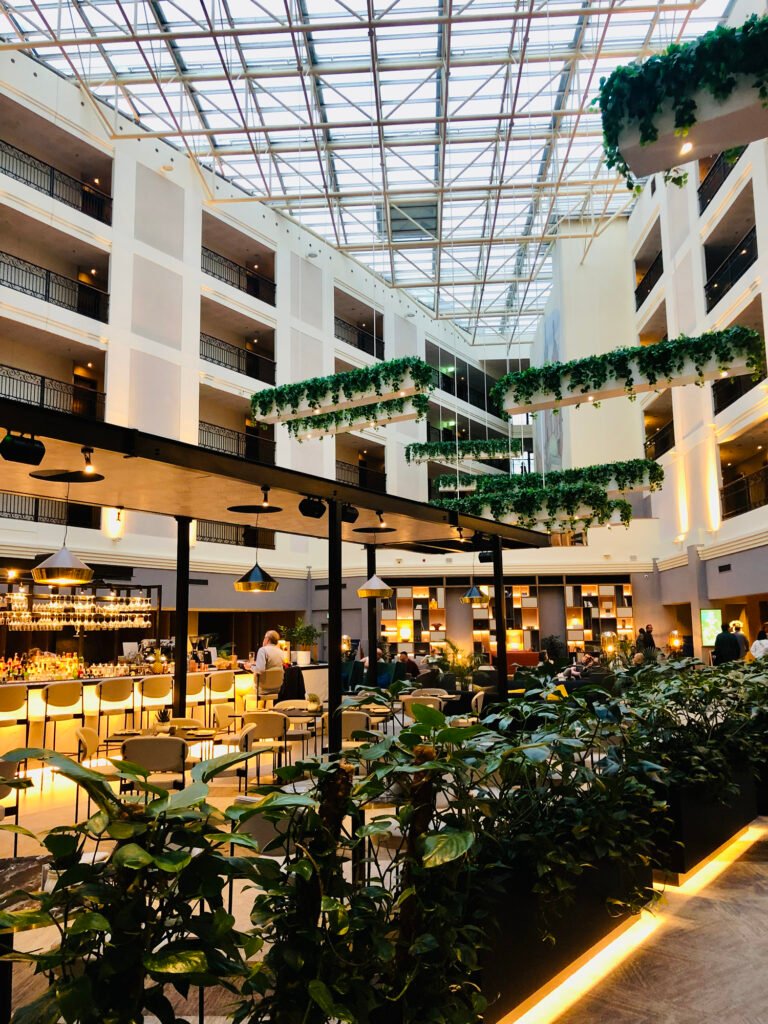
The hotel itself is famous for its massive, glass-roofed central atrium – it’s a stunning, light-filled space to grab a coffee before heading out for the day. But the real “daily gift” was the view. If you can, book a room facing the river; watching the castle silhouette against the morning sky or the river glowing at sunset from my window was a highlight of the trip. Plus, the rooftop terrace is one of the best spots in the city for a sundowner with a 360-degree view of the castle and the Vistula.
While I loved the modern energy of the Sheraton, several of my colleagues swear by the Hotel Copernicus. If the Sheraton is about “grand and modern,” the Copernicus is its “intimate and ancient” counterpart. It is located on Kanonicza Street, widely considered the most beautiful street in Krakow, and is housed in a meticulously restored Renaissance building.
Staying here feels like stepping back into the 1500s. The hotel is a treasure trove of vaulted ceilings and original frescoes, with a unique swimming pool tucked away in a Gothic stone cellar. It has hosted everyone from world leaders to royalty, offering a sense of “old world” luxury that is hard to find elsewhere. It also features a Michelin-recommended restaurant, making it a top pick for anyone who wants to combine deep history with high-end dining.
Finding Your Neighborhood
If you are still undecided, think about the “vibe” you want for your home base. The Old Town (Stare Miasto) is perfect for those who want to be steps away from the Main Square and the evening Chopin concerts. Powiśle, where the Sheraton is located, offers a quieter, scenic riverside experience with great walking paths. Meanwhile, Kazimierz is the place to be if you prefer a “boutique” feel, surrounded by street art, independent cafes, and the city’s most vibrant nightlife.
⏳ Best Time to Visit
- Shoulder Season (late April – May, or September – early October): This was when I visited, and is the “sweet spot”. You’ll find mild weather, beautiful golden-hour light for photos, and slightly thinner crowds at the big sites.
- Summer (June – August): Peak season. You get long daylight hours (sunset near 9:00 PM) and a vibrant, outdoor energy. Just be sure to book your “Top Eight” tours at least 2–3 weeks in advance.
💡 Quick Facts
- Currency: Polish Złoty (PLN)
- Language: Polish (English is very widely spoken in shops and restaurants)
- Time zone: CET (UTC+1) / CEST in summer (UTC+2)
- Power: Type E (standard European two-pin)
- Tipping: 10–15% at restaurants
💭 Final Thoughts
If you are looking for a European city that is equal parts beautiful, affordable, and teeming with history, Krakow belongs at the top of your list. I arrived as a solo traveler on a business trip, my mind more on Q3 forecasts than 12th-century legends. I left promising to return in a heartbeat – no work excuse required.
Krakow has a way of pulling you in. It’s in the way the white horse-drawn carriages clip-clop across the cobblestones, making the medieval square feel like a living film set, or how a salt-carved chapel makes you question what is possible deep underground . It is the warmth of the hospitality, the soul-satisfying comfort of the food, and the vibrant modern life that pulses through its ancient streets.
Whether you are a history enthusiast, an architecture lover captivated by a glowing castle, or simply someone looking to have a good time, this city refuses to be ordinary. Even its founding legend – clever cobbler, a sulfur-stuffed sheep, and a thirsty dragon – is a reminder that Krakow takes its magic seriously.
I came here for meetings. I left with the flour-dusted memories of making pierogi, a new salt magnet on my fridge, and a dragon’s storybook on my shelf. Krakow didn’t just provide a backdrop for work; it became one of my favorite stories to tell.
Have you been to Krakow? I’d love to hear about your experience – drop a comment or send me a message. And if you’re planning your first visit, I hope this guide helps you fall for it the way I did.
Happy Traveling!


Leave a Reply